
Chasing Emptiness

Written (reluctantly) for Day 4 of Bradley Ramsey’s Halls of Pandemonium challenge.
I’ve never had a clean answer for creativity.
Some people can point to a teacher. A musician. A painter. A parent standing at an easel in afternoon light. They tell stories about seeing someone make beauty and suddenly understanding they wanted to do the same.
That never happened to me.
I grew up around sports people. Practical people. The kind of people who measured effort in sweat and repetition. My mother and grandmother were both talented musicians, though I didn’t think of them as “creative” then. It just felt like something they did, the same way other people cooked dinner or drove to work. Years later, my mother developed into an amazing, inspirational painter. One brother earned an art degree from the Corcoran. Another eventually earned his PhD in English Literature, and his depth of insight about writing, the human condition, and the larger world still startles me.
Creativity was around me the entire time, apparently. I just never recognized it as something that belonged to me.
What belonged to me was isolation.
Books helped. So did horror movies and role-playing games and late-night obsessions that lived entirely inside my own head. I read above my age level whenever I could, bouncing between nonfiction and fiction without much distinction. I loved stories, though I didn’t understand why. I loved guitars too, but never learned to play well. I could memorize songs long enough to stumble through them, then lose them almost immediately, as though music refused to stay in my hands.
Most of my early emotional life existed in imagination. I had friends, but what I didn’t have was a creative circle. No group of friends making films or writing stories or playing music together in somebody’s garage.
Mostly, I was obsessed with girls.
Not even romance exactly. More the feeling of orbiting something beautiful and unreachable. Creatures of subtlety, depth, and nuance that maybe—just maybe—I might understand if I immersed myself deeply enough in them. I had a few successes, but far more failures.
In the end, whatever I was searching for happened alone.
Then somebody put a computer in front of me.
This was long before computers became ordinary. Long before the internet. Before everyone carried one in their pocket. The machine itself looked severe and alien—dark screen, blinking cursor, strange commands that felt closer to incantations than language.
But the moment it responded to me, something locked into place.
I could make things.
Not physical things. Entire systems. Tiny worlds made of logic and structure and invisible connections. If something failed, it was because I failed. If it worked, it worked because I had imagined it correctly. There was nobody to ask. No roadmap. Technology changed faster than schools could teach it, so I taught myself.
And I became very good.
For more than forty years, programming consumed my life. I built things constantly. Games. Operating systems. Trading systems. It paid well, though I never cared much about money beyond the freedom it gave me to continue working. To continue building. To raise my children without fear. To disappear deeper into that controlled little universe where everything made sense if you stared at it long enough.
I thought that feeling was fulfillment.
Maybe for a while it was.
But the strange thing about spending your life chasing mastery is that eventually you arrive there and discover the emptiness was inside you all along.
Programming changed too. What once felt rare and magical became ordinary, industrialized, automated. When I started, almost nobody knew how to program. Now it feels like everybody does, or soon will. The mystery evaporated. Somewhere along the way I realized I no longer cared about the work itself. I only cared about making something that felt alive again.
So I started writing.
Badly at first.
I thought writing had to be profound to matter. I thought every sentence needed to justify its own existence. But slowly I began to understand that stories are not puzzles you solve once. They are excavations. Ways of digging toward something hidden.
That frightened me more than programming ever did, because stories reveal the parts of yourself you spent decades learning how to hide behind competence.
I still don’t know if writing is the answer.
Maybe there isn’t one.
But when I sit down to write now, I recognize the feeling I had staring into that first glowing screen all those years ago: the sense that something inside me wants out, and that if I can just find the right arrangement of words, I might finally understand what it’s been trying to say.
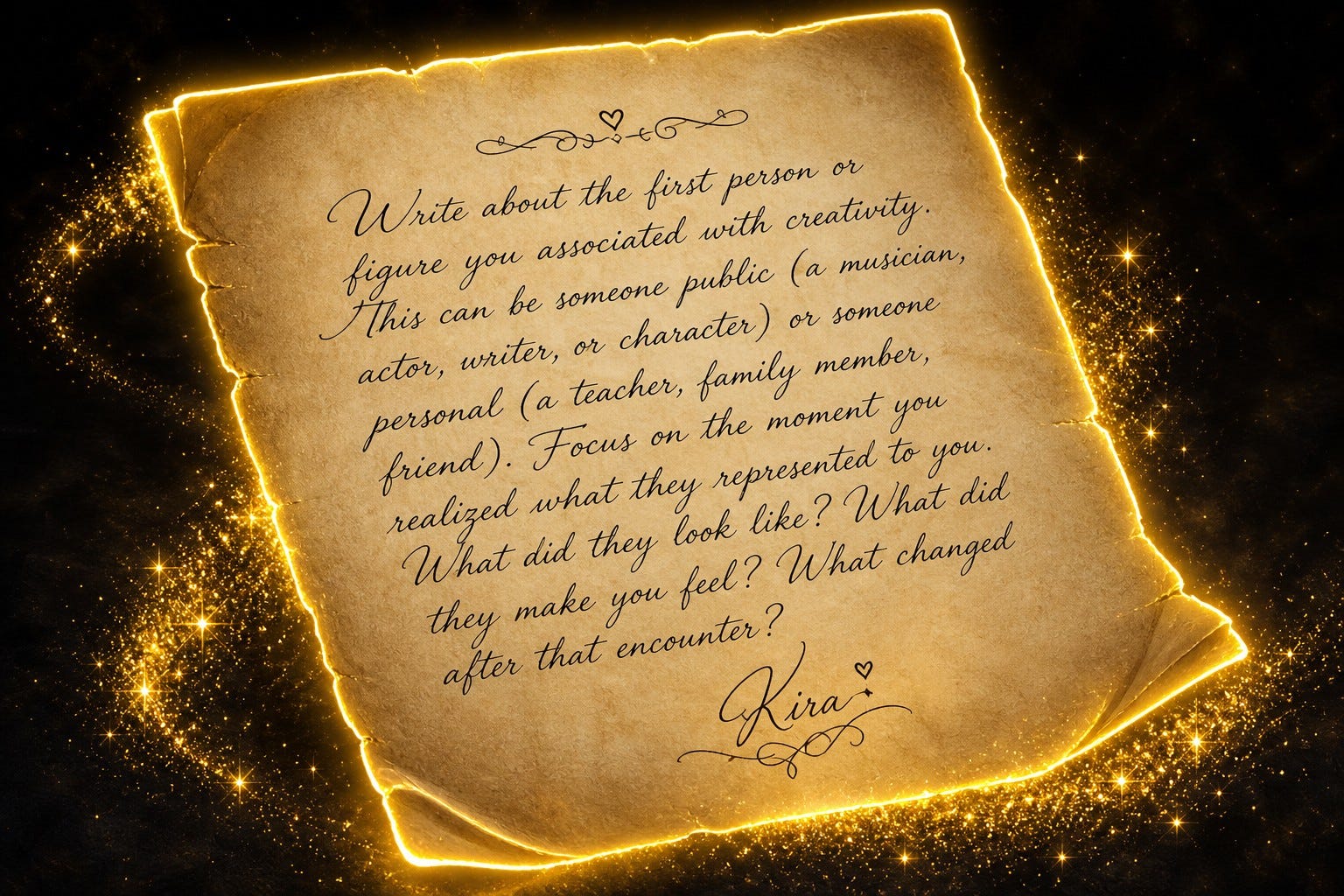
Prompt: Write about the first person or figure you associated with creativity. This can be someone public (a musician, actor, writer or character) or someone personal (a teacher, family member, friend). Focus on the moment you realized what they represented to you. What did they look like? What did they make you feel? What changed after that encounter? -- Kira.
Genre: Nonfiction (yes, really)
Prompt written by: J.M. Gooding
Jack, this says who you are in so many ways, thank you for sharing. 💝
Waiting to "hear about this". :)
If you felt uncomfortable or weird writing this, you did what you were supposed to. The goal of this prompt is for you articulate exactly what you did: that writing fiction reveals part of yourself you've been hiding. Fiction almost always carries truth buried inside the author.
You said the hard thing out loud, and that's one of the things I wanted people to accomplish with this.